
ERP SOFTWARE | 4 MIN READ
The 7 Best ERP Software in 2026
Curated list of the best manufacturing ERP software ranked for Production, Inventory, and Supply Chain Management.
TABLE OF CONTENTS
Looking for the best ERP software for manufacturing? We've reviewed the top seven systems for 2026. Compare features, pros and cons, and pricing for Acumatica, Microsoft Business Central, NetSuite, and more.
Choosing the Right Manufacturing ERP
Most modern enterprise resource planning (ERP) solutions are equipped with manufacturing tools that manage supply chains, inventory, sales orders, financials, and more. But no two ERPs are the same, which means the best ERP for one manufacturer may not be ideal for another.
The most well-received and widely-used manufacturing ERPs focus on integrative capabilities, process automation, and regulatory compliance. Many modern manufacturing ERPs are also designed to keep pace with customer demand and organizational growth.
Best ERP for Manufacturing
As a B2B software implementation company, Cargas has hands-on experience with some of the top manufacturing ERPs. We're familiar with the most popular operations platforms across the manufacturing industry and the features that users want most, like BOM, WIP tracking, and shop floor data collection. Based on our knowledge of manufacturing company needs, we've created a list that covers the top seven ERP solutions for manufacturers. Read on to find your best fit.

Acumatica
Best for Usability & Flexible Pricing
Acumatica Manufacturing Edition is a cloud-based ERP system built for small and mid-sized manufacturing companies. Based on the core Acumatica General Business Edition platform, Acumatica Manufacturing Edition blends crucial ERP features like financials, reporting and dashboards, and customer management with manufacturing-specific capabilities like MRP, MPS, and supply chain management.
Acumatica’s accessible user interface makes the software easy to learn, while its data centralization, quality control, and production management features offer plenty of depth as manufacturing organizations evolve over time.
Unlike traditional ERPs, Acumatica’s investment is tied to your manufacturing scale and monthly transaction volume rather than a per-user seat count. This flexible model ensures the software grows with you, but it also means a generic estimate won’t give you the full picture. Fill out the form below to access our Pricing Calculator and see how this consumption-based model fits your specific business.
The price of Salesforce Sales Cloud will depend on the size of your sales team and the licenses you choose to purchase. On average, businesses spend about $9,000 to $27,000 on their annual subscription, while implementation costs typically start around $15,000. Fill out the form below to access our Salesforce Sales Cloud Pricing Calculator and get a price estimate tailored to your business.

Business Central
Best for Scalability & Microsoft Users
Business Central is a cloud-based ERP from Microsoft. As part of the Dynamics 365 platform, Business Central seamlessly integrates with popular Microsoft solutions like Dynamics 365 CRM, Microsoft 365, and the Power Platform. By adding Business Central into a manufacturing tech stack, users can build an autonomous, centralized data hub that offers real-time production insights, production cycle and sales order forecasting, and multi-location operations management.
Business Central is a versatile manufacturing ERP that works well for different organization types; although it is best for discrete manufacturers, integrations can broaden its capabilities to include comprehensive process manufacturing capabilities. Its broader features for financial management, sales, and marketing allow manufacturers to bridge data gaps across the business. This way, teams can focus on fast, lean production cycles while ensuring every team member has access to the most relevant business data.
Business Central’s comprehensive capabilities are organized into ten core categories—all included with a Premium license—spanning Finance Management, Sales & Marketing, Sales & Delivery, Purchasing Payables, Inventory, and Supply Planning & Availability, alongside robust modules for Project, Warehouse, Service, and Manufacturing management. These interconnected tools synchronize to help manufacturers seamlessly satisfy customer orders, optimize cash flow and inventory, anticipate future demand, and strengthen vendor relationships. By leveraging advanced workflow automation, Business Central eliminates the burden of manual workloads, freeing manufacturers to shift their focus from administrative overhead to strategic business growth.
The investment for Business Central is highly scalable, shifting based on your manufacturing volume, user count, and specific operational requirements. Because no two implementations are identical, a ‘sticker price’ rarely tells the whole story. To see exactly how the platform scales for your specific footprint, use our Business Central Pricing Calculator below for a tailored estimate.

Oracle NetSuite
Best for Large Global Enterprises
Oracle NetSuite is a large-scale ERP designed for enterprise-level organizations in industries like manufacturing. NetSuite manages everything from production on the shop floor to the data that executives leverage for decision-making.
Oracle NetSuite's greatest strength is its multi-location and multi-entity capabilities, which help the largest and most diverse manufacturers keep production on schedule and avoid stock-outs and overstocking. NetSuite offers analytics for every product on the shop floor across multiple manufacturing facilities and warehouses.
Oracle NetSuite is an all-in-one platform that can integrate with hundreds of third-party solutions, but its core functionality is broad enough for many organizations on its own. For manufacturers, NetSuite groups key capabilities into seven areas—order management, planning and scheduling, supply chain management, procurement, shop floor management, quality management, and CRM and marketing—helping consolidate data across multiple locations, keep teams connected, and centralize customer, process, and procurement information in one place.
The price of Oracle NetSuite will depend on the size of your manufacturing organization and the number of user licenses you require. More details can be found by contacting NetSuite.

Epicor Kinetic
Best for Highly Niche Industrial Manufacturing
Epicor is a manufacturing-specific ERP built to handle processes across multiple industries, including automotive, aerospace, construction, engineering, rubber, plastics, electronics, and more. Epicor's solutions cover functionality gaps for niche industries and serve as best-in-class manufacturing applications as opposed to offering broad ERP features.
Epicor offers flexible deployment options—cloud, on-premises, and hybrid—as well as no-frills pricing and out-of-the-box functionality. Plus, by connecting to IoT-enabled devices, Epicor pulls data from the shop floor directly into the software to improve operations, generate insights, and scale production.
Epicor Kinetic is Epicor’s cloud-based manufacturing ERP, with capabilities spanning eight main categories: financials, business intelligence and analytics, supply chain management, planning and scheduling, production management, services and assets, internet of things (IoT), and risk and compliance. Epicor also offers additional modules for areas like customer relationships, project management, global business, requisitions, and more—so manufacturers can bundle what they need to expand functionality and improve productivity across the business, starting on the shop floor.
The price of Epicor will depend on the size of your manufacturing organization and the number of user licenses you require. More details can be found by contacting Epicor.
SAP Business One
Best for Businesses on SAP Ecosystems
SAP Business One is an ERP solution for small and mid-sized businesses, including manufacturers. It handles everything from accounting to customer relationships to inventory, plus it comes equipped with integrated business intelligence to deliver data trends across the organization.
Despite being designed for smaller businesses, SAP Business One offers a variety of features and seamless integrations with e-commerce tools. Although SAP solutions are most reliable when integrated with one another, third-party software can connect with SAP to cover areas beyond procurement, production, and distribution.
SAP Business One supports multiple roles across the organization—including accountants, project managers, production managers, and sales teams—with core features for financial management, sales and customer management, purchasing and inventory management, business intelligence, and analytics and reporting. While it may not offer deep functionality in every area out of the box, SAP Business One can integrate with other SAP solutions like SAP Digital Manufacturing (a cloud-based MES) and select SAP S/4HANA modules for planning, scheduling, and more, making the broader SAP tech stack a viable option for large, global organizations.
The price of SAP Business One will depend on the size of your manufacturing organization and the number of user licenses you require. More details can be found by contacting SAP.

Sage X3
Best for Financial Depth
Sage X3 is an end-to-end discrete and process manufacturing system for large enterprises. Although it does not have the same depth of financial capabilities as Sage Intacct—a dedicated best-in-class accounting solution by the same developers—Sage X3 still boasts more in-depth accounting functionality than other manufacturing solutions on the market.
Accounting features are baked into ERP systems, but manufacturers with complex operations may need deeper financial capabilities than what a traditional ERP offers. Sage X3 closes that gap by combining quality control and process manufacturing features with robust data analysis capabilities.
Sage X3 groups its manufacturing capabilities into three broad areas—production management, supply chain management, and financial management—while still offering deep functionality to manage the shop floor, product quality, projects, purchasing, sales, and finance in one system. Its financial management module is built to support multi-currency, multi-tax, and multi-company operations, which makes Sage X3 a strong fit for larger manufacturers with complex production cycles and business structures.
The price of Sage X3 will depend on the size of your manufacturing organization and the number of user licenses you require. More details can be found by contacting Sage.
Plex
Best for Automotive/Heavy Industrial
Plex is Rockwell Automation’s manufacturing platform for process automation and data analytics. Although Plex is valuable for many different industry types, its ability to manage the most complex quality and supply chain requirements makes it a perfect fit for heavy industrial and automotive manufacturing.
Plex is best suited for manufacturers with strict compliance requirements and complex, multi-stage production timelines, though its breadth of features can be beneficial for many types of manufacturers.
Plex offers a suite of products that manufacturers can mix and match based on their needs, including a manufacturing execution system (MES), quality management system (QMS), enterprise resource planning (ERP), supply chain planning, Connected Worker (a collaboration tool), production monitoring, MES automation and orchestration, and asset performance management. Together, these modules integrate to manage multiple areas of the organization at once while centralizing essential business data to keep stakeholders informed and support better decision-making.
The price of Plex will depend on the size of your manufacturing organization and the number of user licenses you require. More details can be found by contacting Plex.
Comparison Reports
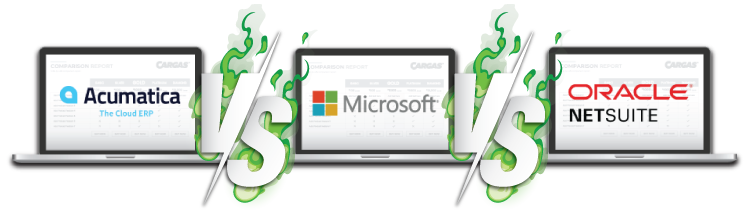
Still having trouble deciding which manufacturing ERP is the best fit for your business? Dig deeper into the big three manufacturing ERPs—Business Central, Acumatica, and Oracle NetSuite—to gauge whether these top-rated solutions are right for your organization.
How to Choose the Best ERP for Shop Floor
Selecting the right manufacturing ERP for your organization requires a thorough understanding of your business processes, your industry, and the solutions available on the market.
You don't have to sort through all this alone, though—a dedicated software partner like Cargas can help you evaluate not only your ERP options, but any additional software you need in your manufacturing tech stack.
Contact us today to discover your best-fit manufacturing ERP and develop a reliable, scalable platform for your operations.

Let’s Chat
Still have questions? Get in touch with our expert team of software professionals.