MANUFACTURING | 4 MIN READ
What Is Manufacturing Accounting Software?
How can manufacturing accounting software help you track costs, manage cash flow, and keep your financial operations connected to production?
TABLE OF CONTENTS
- How Accounting Software Supports Manufacturers
- What Does Manufacturing Accounting Software Do?
- Who Uses Manufacturing Accounting Software?
- Accounting Software vs. ERP for Manufacturing
- Signs You've Outgrown Spreadsheets and Legacy Systems
- Choosing Accounting Software for Your Business
- Choosing a Accounting Software Partner
- Manufacturing Accounting Software FAQ
Accounting software is a type of solution that manages business financials for various industries, including manufacturing. These solutions may be narrower in scope than traditional operational tools like ERPs, but they offer tremendous depth when it comes to controlling business costs, managing inventory, automating invoices, and enabling organizational growth. But how do you know if an accounting solution is the right choice for your manufacturing company? Read on for a complete breakdown of what accounting software does, how it benefits manufacturers, and why you should consider the investment.
How Accounting Software Supports Manufacturers
Whether they’re building budget reports or reviewing financials across multiple warehouses and shop floors, today’s manufacturers need instant access to accounting data. Accounting software takes that valuable data out of spreadsheets and monitors it in real-time to ensure that finance experts, project and plant managers, and other manufacturing business leaders have instant access to the data that matters most. The time these teams save by automating financial data collections, reconciliations, and other key responsibilities can then be spent making informed business decisions that help the organization evolve.
Generic Accounting vs. Manufacturing Accounting
| Generic Accounting Software | Manufacturing Accounting Software |
|---|---|
| Basic GL | WIP tracking |
| Simple inventory | BOM management |
| Manual costing | Real-time cost visibility |
| Limited production insight | Production-aware reporting |
What Does Manufacturing Accounting Software Do?
Manufacturing accounting software manages financial data as it moves into, out of, and through the business. The software tracks cash flow, inventory, sales orders, and invoices to ensure every dollar is accounted for. Read on to learn about the specific features and benefits of manufacturing accounting software.
Core Features of Manufacturing Accounting Software
- Core Accounting Features: Balance the books with a general ledger and features to automate accounts payable and receivable.
- Bill of Materials (BOM): Track raw material and finished product information, including material prices.
- Inventory Management and MRP: Automate control of inventory levels across multiple shop floors and reduce shortages with replenishment features.
- Job Costing and Production Tracking: Ensure production stays within budget with up-to-the-minute views of shop floor activities and production progress.
- Sales Orders: Speed up quote to cash with workflow automations that streamline purchasing.
- Reporting: Gather financial data from across the business, including other integrated solutions, to share in comprehensive reports and dashboards.
Key Operational Benefits of Accounting for Manufacturers
Certain accounting software features can be found in other manufacturing systems; for instance, MRP software can be purchased on its own to manage materials and production planning, while ERP solutions often include sales order management capabilities. Although accounting software is narrower in scope than these solutions, it offers deep functionality that finance teams need for bookkeeping, project costing, and inventory management. Here's what accounting software helps manufacturers do:
- Get deeper insights into operational expenses with financial features for sales, operations, and more.
- Manage costs more effectively by tracking and allocating the costs of jobs, resources, products, and more.
- Improve inventory management with at-a-glance readouts of raw materials, works in progress, and finished goods.
- Enable faster, more informed decision-making with accessible reports and dashboards built on real-time data.
- Ensure compliance with software that handles tax calculations, report generation, and data entry and updates.
- Speed up quote-to-cash with automated invoicing and workflows that streamline customer payments.
Who Uses Manufacturing Accounting Software?
Manufacturing accounting software cuts down on manual workloads for every member of the finance team:
- CFOs and finance leaders use manufacturing accounting software to gain real-time visibility into cash flow, profitability, and KPIs.
- Accounts payable teams use the software process vendor invoices faster, cutting down on late payments and other avoidable errors.
- Multi-entity and consolidation teams get a complete view of job costs across multiple locations with manufacturing accounting software.
- Controllers and accounting managers get more control over financial data to ensure accuracy and stay compliant.
- Accounts receivable and billing teams use manufacturing accounting software to improve invoicing and collections by automating the billing process.
- Executive leadership also benefits from manufacturing accounting software, gaining access to real-time data in reports and dashboards to make smarter, faster business decisions.
Accounting Software vs. ERP for Manufacturing
Is an accounting solution enough for a manufacturer, or should it be purchased alongside an ERP application? The answer to this question depends on the specific needs of individual manufacturers.
ERPs are traditionally broader in scope than accounting systems; where ERPs offer features for different areas of operations, accounting software is narrower in scope with deep financial capabilities. This means that ERPs are better suited than accounting software for intensive operational needs, such as production management and scheduling, while accounting solutions deliver deep financial features that ERPs can’t match.
It may seem like manufacturers should choose one solution over the other.
Signs You've Outgrown Spreadsheets and Legacy Systems
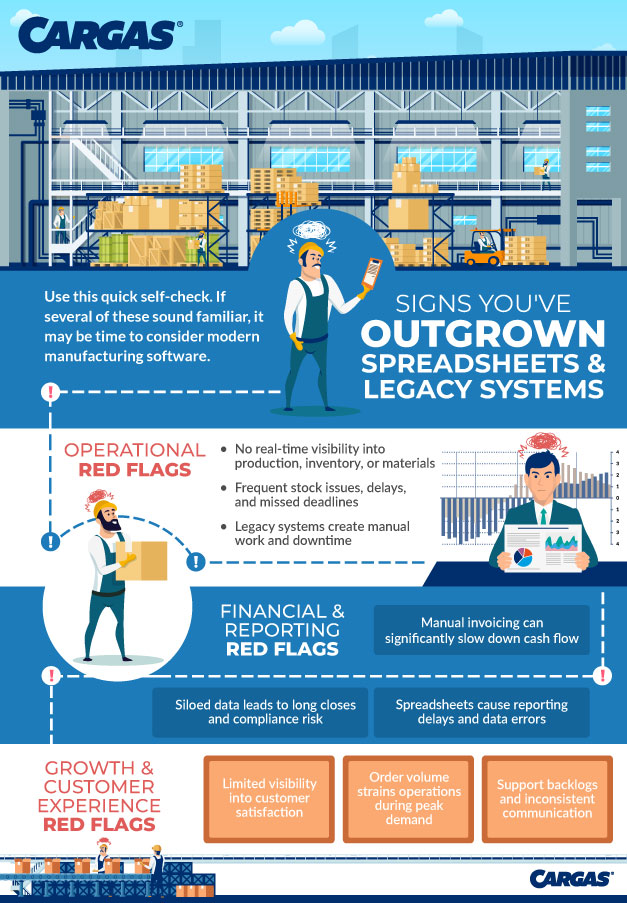
Whether you currently use an accounting application for manufacturing or are still team spreadsheet (or team pen and paper), it's important to step back and review how you run day-to-day operations. If you're spending more time building workarounds than actually getting work done—or if you keep thinking, "I wish we could automate this"—you've likely outgrown your current tech stack.
Curious if your manufacturing business is outgrowing spreadsheets and legacy systems? Our infographic walks you through red flags that impact operations, finances, and growth:
Choosing Accounting Software for Your Business
Choosing the right accounting system for your manufacturing business requires a deep understanding of your unique business processes, available budget, and desired features and functionality. It also means plenty of collaboration with leadership and IT as well as the finance team members who will be end-users of the software.
This checklist will guide internal conversations to help your team determine the best path forward as your manufacturing organization considers investing in an accounting:
- Determine financial tasks that require the most manual input and would be much more manageable if automated
- Identify financial data blind spots and chart how your current systems do or do not communicate information
- Explore what accounting solutions your industry competitors use
- Chart your anticipated company growth to determine required personnel and the ideal budget for your new system
- List the other solutions you currently use that your new accounting software will need to integrate with
- Consider additional assistance you may require, such as user training and ongoing support
Choosing a Accounting Software Partner
Choosing a manufacturing accounting solution isn't just about picking a system—it's about finding a partner who can help you build a tech stack that supports your production, your people, and your growth goals. The right partner will help you evaluate where you are today, identify gaps in your processes, and support your tech stack beyond just your accounting software.
Cargas is a dedicated, long-term software partner for manufacturers. Our team works with you to compare options, validate fit, and design an integrated software ecosystem that supports everything from demand planning and production scheduling to quoting, billing, and customer service. Once you've selected the right tools, we'll handle implementation, integrations, and user training. And as your operations evolve, we'll stay engaged with ongoing support, training, and customizations.
Cargas is an employee-owned software company and proud partner of Sage Intacct—a top accounting solution for industries like manufacturing—plus a variety of other integration-ready solutions for sales and marketing, operations, and business intelligence. Our team brings both variety and deep expertise to your software search. If you're starting to explore manufacturing accounting solutions, or you're ready to replace spreadsheets and legacy systems, we can help you clarify requirements, avoid common pitfalls, and move forward with confidence. Reach out to start a conversation about your manufacturing software roadmap.
Manufacturing Accounting Software FAQ
Let’s Chat
Still have questions? Get in touch with our expert team of software professionals.