MANUFACTURING | 4 MIN READ
What Is Manufacturing CRM Software?
How can the right manufacturing CRM help you streamline sales, strengthen customer relationships, and support long-term growth?
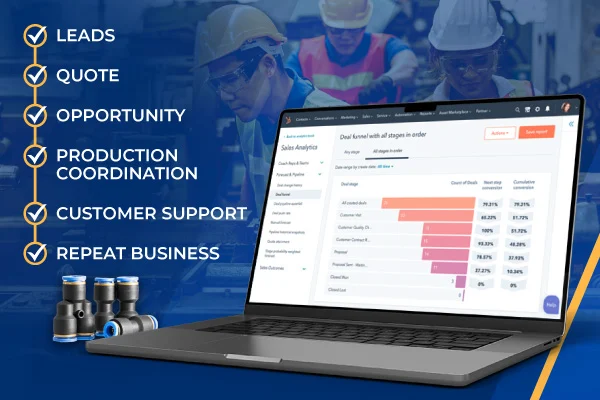
Customer relationship management (CRM) is an umbrella term for solutions used by sales, marketing, and customer service teams to close deals, run targeted campaigns, and assist customers with questions or issues. These collaborative platforms help users improve customer satisfaction and save hours each week with customizable automated workflows. But what makes a CRM a good fit for your manufacturing organization? Our ultimate guide to CRM software for manufacturing explores all this and more.
| Generic CRM Software | Manufacturing CRM Software |
|---|---|
| Tracks deals | Tracks customer + operational workflows |
| Sales-focused | Sales + production visibility |
| Basic pipeline | Quote-to-order coordination |
| Limited forecasting | Demand & account forecasting |
| Disconnected data | ERP-integrated visibility |
What Does Manufacturing CRM Software Do?
Manufacturing CRM software helps sales, marketing, and customer service teams automate workflows and build strong customer relationships. Read on to learn about the specific features and benefits of manufacturing CRM software.
Core Features of Manufacturing CRM Software
Manufacturing CRM software includes a broad suite of features for sales, marketing, and customer service:
| Sales | Marketing | Customer Service |
|---|---|---|
| Lead tracking & management | Customer segmentation | Automated ticket routing |
| Account & contact management | Multi-channel marketing | Warranty lifecycle management |
| Sales territory management | Email & social media marketing | Self-service customer support tools |
| Sales forecasting | Campaign automation | Surveys & feedback tools |
| Sales order management | Lead scoring | Multi-channel support |
CRMs also offer robust data capabilities for manufacturers, including the ability to customize and build reports and dashboards using real-time data, and to share them across the organization.
In addition, some modern CRMs can be customized to include vendor relationship management (VRM) capabilities that track key supplier and vendor information, including contracts and renewals.
Key Operational Benefits of CRMs for Manufacturers
CRMs are most beneficial for sales, marketing, and service teams that want to dedicate more time and attention to new and existing customers, but many benefits ripple out to impact the entire organization:
- Improve sales territory management by segmenting territories into more manageable components that meet customer needs.
- Keep sales, marketing, and service teams connected to the rest of the organization with collaborative, integration-friendly software.
- Save hours each week by automating redundant activities such as personalized customer outreach.
- Get a complete view of customer accounts, including purchase history, contact information, and communications across multiple channels.
- Manage vendor and supplier relationships with customizable modules for contacts, renewals, and more.
- Enable faster, more informed decision-making with accessible reports and dashboards built on real-time data.
- Stay ahead of sales orders with demand forecasting that keeps your production team and shop floor prepared.
Who Uses Manufacturing CRM Software?
Manufacturing CRM software is primarily designed for alignment between sales, marketing, and customer service professionals:
- Sales managers and their teams use CRM software to close more deals in less time by managing sales territories, then use that data to forecast future demand and production needs.
- Marketing, leadership, and operations stakeholders use CRM software to launch, execute, and evaluate campaigns that convert prospects into buyers.
- Customer service and account management teams use CRM software to maintain positive customer relationships via timely support and self-service tools.
Do Manufacturers Need a CRM?
Do manufacturers need a CRM if they’ve already invested in other solutions like ERP, MES, and MRP? The answer to this question depends on the specific needs of individual manufacturers and their sales, marketing, and service teams. Manufacturers with complex sales cycles or nuanced support requests will likely see a CRM as an invaluable resource that saves time, eliminates bottlenecks, and ultimately improves customer satisfaction.
ERP and CRM Integrations for Manufacturers
Although enterprise resource planning (ERP) software sometimes includes basic sales features, these capabilities are typically limited to sales order fulfillment. This is why CRMs pair so well with ERPs—CRMs flesh out many of the customer-focused capabilities within the ERP to broaden and diversify available data within a manufacturer's tech stack. In practice, this helps teams…
- Improve demand forecasting and production planning with more comprehensive order history and account behavior data.
- Boost customer satisfaction with self-service support tools and automated ticket routing.
- Develop marketing campaigns based on inventory stock, production schedules, and customer interest.
- Create better visibility from quote to delivery to understand where production can be streamlined.
- Simplify sales territories by segmenting to target best-fit customers without adding more work for the sales team.
We've gathered data on the top ERPs for manufacturing companies like yours. Check out our blog to discover the power of advanced operational software for manufacturers.
Choosing CRM Software for Your Business
Choosing the right CRM system for your manufacturing business requires a deep understanding of your unique business processes, available budget, and desired features and functionality. It also means plenty of collaboration with leadership and IT as well as end users, including sales managers, marketing team members, and customer service reps.
This checklist will guide internal conversations to help your team determine the best path forward as your manufacturing organization considers investing in a CRM:
- Determine areas that require the most manual input and would be much more manageable if automated
- Identify business data blind spots and chart how your current systems do or do not communicate information
- Explore what CRMs your industry competitors use
- Chart your anticipated company growth to determine the required personnel and the ideal budget for your new system
- List the other solutions you currently use that your new CRM will need to integrate with
- Consider additional assistance you may require, such as user training and ongoing support
Choosing a CRM Software Partner
Choosing a manufacturing CRM isn't just about picking a system—it's about finding a partner who can help you build a tech stack that supports your production, your people, and your growth goals. The right partner will help you evaluate where you are today, identify gaps in your processes, and support your tech stack beyond your CRM.
Cargas is a dedicated, long-term software partner for manufacturers. We work with you to compare options, confirm fit, and design an integrated software ecosystem that supports sales, marketing, and customer service. Once you've selected the right tools, we'll handle implementation, integrations, and user training. And as your operations evolve, we'll stay engaged with ongoing support, training, and customizations.
As an employee-owned software company and proud partner of top manufacturing CRMs from HubSpot, Microsoft, and Salesforce—plus a variety of other integration-ready solutions for operations, accounting, and business intelligence—Cargas brings both variety and deep expertise to your software search. If you're starting to explore manufacturing CRMs, or you're ready to replace spreadsheets and legacy systems, we can help you clarify requirements, avoid common pitfalls, and move forward with confidence. Reach out to start a conversation about your manufacturing software roadmap.
Manufacturing CRM FAQ

Let’s Chat
Still have questions? Get in touch with our expert team of software professionals.